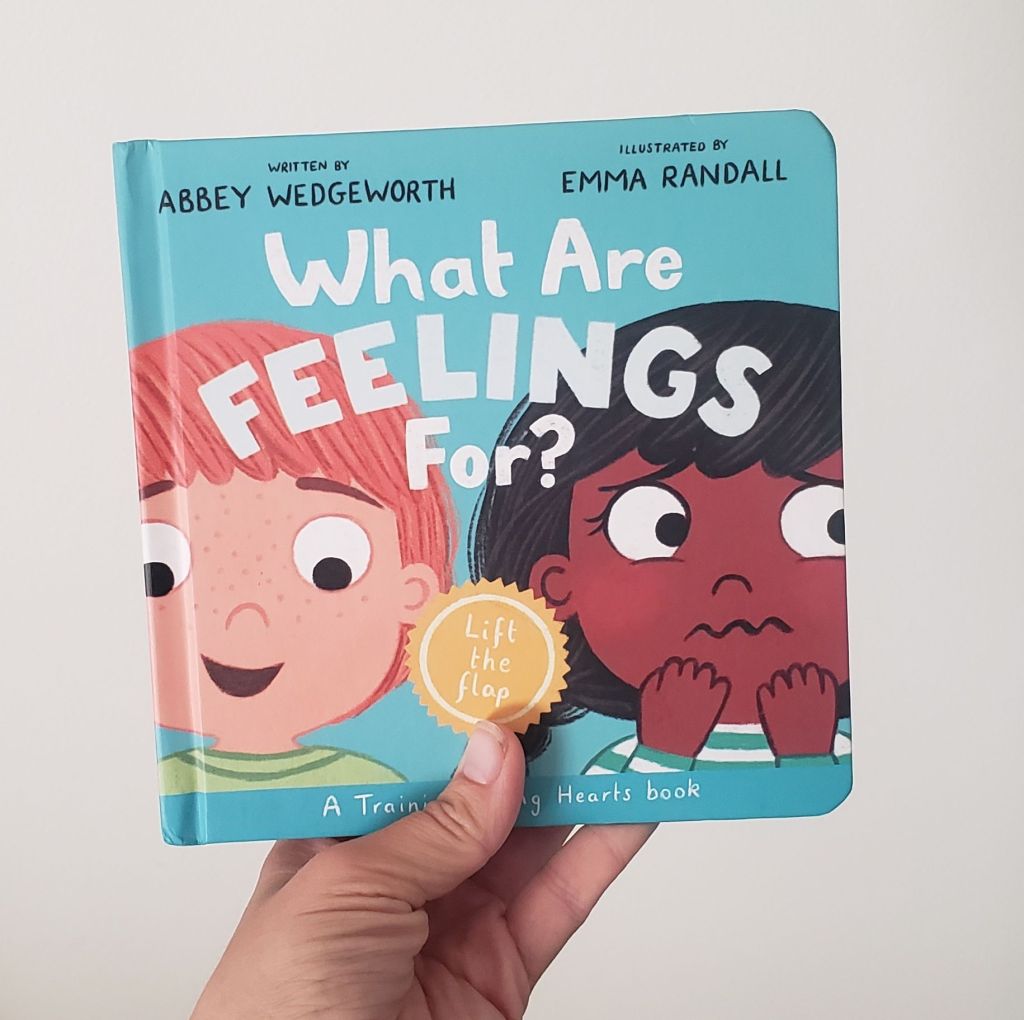
Big feelings are very much a reality in our home. Learning how to navigate, regulate, and appropriately express our big emotions has for sure been a journey. So my curiosity was peaked when I saw Abbey Wedgeworth had released a new addition to her ‘Training Young Hearts’ series: ‘What Are Feelings For?’
‘What Are Feelings For’ is a book that encourages kids to see that all their feelings are valid, but not every behavior is appropriate. However, no matter what, God is with us in our big feelings.
Disclaimer: this post contains affiliate links.
What Are Feelings For?
What Are Feelings For? seeks to show littles that their emotions are good! God made them to help us recognize our needs so they can be communicated and fulfilled in appropriate ways. However, there are also inappropriate ways to communicate our feelings and meet those needs. Jesus is there with us in our feelings, even when we don’t choose an appropriate way to express them. He identifies with us, and gives us the Holy Spirit to comfort us and guide us in expressing our emotions in positive ways.
The book features lift-the-flap pages, showing children experiencing a variety of emotions and different ways they express their emotions (both in positive and negative behaviors). They show children on a roller coaster, their emotions telling them they’re happy and having fun. It also shows different ways Jesus experienced and expressed his emotions. With the message that Jesus is with us no matter how we are feeling.

My Thoughts
As mentioned above, we have lots of big feelings over here. So I really love finding faith-based books that explore emotions. I like that it affirms every emotions is valid, but not every behavior is appropriate. Additionally, I really appreciate the commitment the series has to diverse representation. There are children illustrated from a variety of races, as well as children with disabilities.
However, this book is not without a few critiques. All books that use faith, and Jesus to modify behavior I will probably have a few thoughts on. On the topic of emotions and behaviors, I have a hard time labeling a child’s emotion-driven actions as sin. Especially if the action has not harmed another child. Negative behaviors attached to emotions often are due to a lack of skills.
In the book they show a little girl make a mistake on her picture, and angrily rip it up. Then she is left crying. The text reads ‘So when I let my feelings control my actions I can ask Jesus for forgiveness.’ Having been in similar situations with my own child, I have a really hard time treating this as sin needing forgiveness. Treating this action as needing forgiveness feels like it’s alluding to the action being sin. And it just doesn’t sit right with me, as this child is probably lacking in skills of self-regulation, and expressing emotions. These things are developed and grown, children are not born with these skills readily available, and this is an area where neuordivergent children tend to struggle in general. This makes it really hard for me to categorize this as sin.
In addition, a few pages prior, they state ‘Jesus felt all kinds of feelings, but he NEVER sinned’, pairing it with Jesus flipping tables in the market (if you keep reading that story from John 2, he also whipped the money changers). And yet, he was without sin. So classifying a child’s dysregulated emotional outburst as sin feels really contrary to me. Though it may not have been the most appropriate emotional expression, it didn’t hurt anybody. Where is the forgiveness needed? Instead I’d feel more inclined to let them know Jesus sees them and loves even when they are having a hard time regulating their emotions.
I also would have liked to see more skills explored for navigating the negative emotions, as often times negative behaviors related to emotions is a skills issue. The illustrations generally show a child having a negative emotion, and then the solution is to talk with a grown-up. Which, yes, co-regulation is a fantastic skill, but sometimes is not an option. And the emotions where co-regulation is not used, there really isn’t another skill that is explored. The child just seems to get-over their feelings. I do recognize this is a board book, so the format needs to be kept simple, but regardless I think it could have been nice to explore this more, and it can be something for parents to keep in mind as they read this book with their own kids.

My Kid’s Thoughts
I read this one with my kiddo that especially struggles with big emotions. They really liked this book for the most part. They enjoyed the illustrations and even commented on the different kids with disabilities represented. They also enjoyed naming all of the feelings the kids’ experienced.
While reading, we discussed which zone of regulation each child appeared to be in. Then we talked about what skills they may have been able to use to get calm and express their emotions appropriately.
Do I recommend this book?
What Are Feelings For? By Abbey Wedgeworth has a lot of really good things going for it. I think this can be a good faith-based resource to supplement talking about emotions. However, I recommend using it in conjunction with other reaources that can give a wide range of tools to help children build their emotional intelligence. I’m not sure I would recommend it for kiddos who struggle with self-regulation, as I feel some of the scenes discussing this as sin could leave a child feeling shamed when they really are just lacking in skills and development.
 Baby Devotions